
REVIEW · VALLEY OF THE KINGS & KING TUT TOMBS
From Hurghada Individual excursion to Luxor & the Valley of the Kings
Luxor at sunrise is a time machine. With a 5:00 a.m. pickup from Hurghada and a private vehicle, the day stays efficient and you have your Egyptologist close by for real context, not just directions. The catch is the pace: it is roughly a 14-hour day, so you need an early bedtime.
I also really like how the route covers the big Luxor highlights without making you juggle tickets or timing. You get Karnak Temple in East Thebes, tomb time in the Valley of the Kings, then the Colossi of Memnon and Hatshepsut at Deir el Bahari on the west bank.
In This Review
- Key highlights
- Hurghada to Luxor: that early pickup and the long, worth-it ride
- Karnak Temple on the east bank: seeing the largest complex in Egypt
- Valley of the Kings: 3 tomb chambers and the New Kingdom backstory
- One practical consideration
- Colossi of Memnon: quick, famous, and strangely powerful
- Hatshepsut at Deir el Bahari: limestone terraces and a west-bank anchor
- What the Egyptologist does for you, and why the small group matters
- Lunch, tickets, and the parts people forget to budget for
- Price and value: is $221 per person fair for a full Luxor day?
- Timing tips to make the 14-hour day feel manageable
- Should you book this Hurghada to Luxor day trip?
- FAQ
- What time will I be picked up from Hurghada?
- How long is the Luxor day tour?
- Is lunch included, and are drinks included?
- What does the tour include in the Valley of the Kings?
- Are entrance fees included for the sites?
- How big is the group?
- Does the tour use mobile tickets?
- What happens if the weather is bad or I need to cancel?
Key highlights
- Early 5:00 a.m. start that helps you hit Luxor with energy before the crowds and heat set in
- Small group with max 8 people, so your Egyptologist can answer questions as you go
- Karnak Temple, East Thebes, the largest temple complex in Egypt on the Nile’s east bank
- Valley of the Kings visit with 3 burial chambers, plus the New Kingdom story behind the rock-cut tombs
- Colossi of Memnon with two huge Amenophis III statues looking toward the Nile
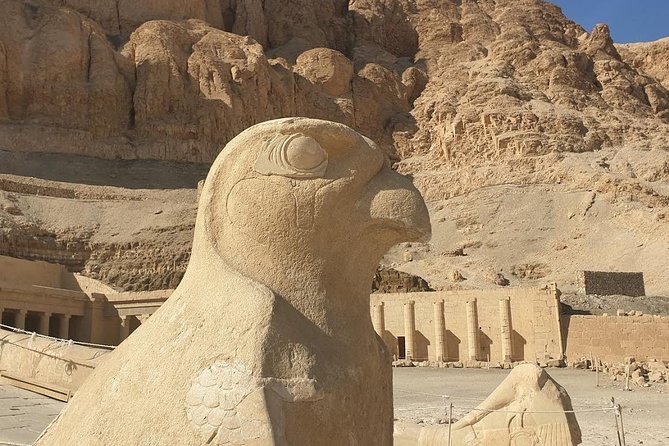
- Hatshepsut’s terrace temple at Deir el Bahari, one of the best-preserved west-bank monuments in Thebes
Other tomb tickets in the valley
- Small group Hurghada to Luxor, Valley of the Kings by Van★ 4.5 · 2,470 reviews
- Hurghada: Small-Group Luxor Highlights & Tut Tomb Day Tour★ 4.6 · 928 reviews
- Hurghada: Luxor Highlights & King Tut Tomb Tour with Lunch★ 4.7 · 902 reviews
- Small Group Excursion to Luxor Valley of the Kings from Hurghada★ 5.0 · 637 reviews
Hurghada to Luxor: that early pickup and the long, worth-it ride
This is built as a full day out of Hurghada. The schedule starts around 5:00 a.m., when your guide meets you and you roll toward Luxor on a comfortable, air-conditioned vehicle. You cover about 4 hours each way past fields, houses of farmers, and the Nile valley scenery. That sounds like “just driving,” but in practice it matters, because it sets you up for a calmer, more informed visit once you reach Luxor.
The “14-hour day” detail is the only real mental hurdle. You are awake early, you will spend hours on the road, and you will walk a fair bit at temple and tomb sites. The upside is that you get a full sweep of Luxor’s most famous areas: East Thebes temples first, then the west bank tomb and mortuary landscape later.
If you do not love early starts, plan to treat this like a one-day reset: water first, snacks if you need them outside of lunch, and comfortable shoes. Also, remember that the day is long even though it is “only” a day trip. Your best strategy is to stop thinking in hours and start thinking in stops.
Karnak Temple on the east bank: seeing the largest complex in Egypt
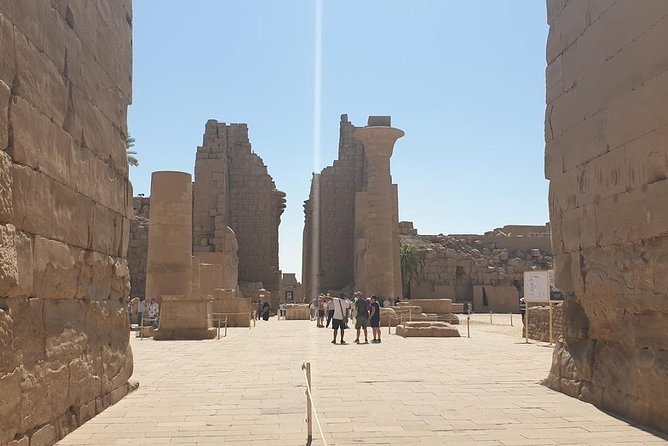
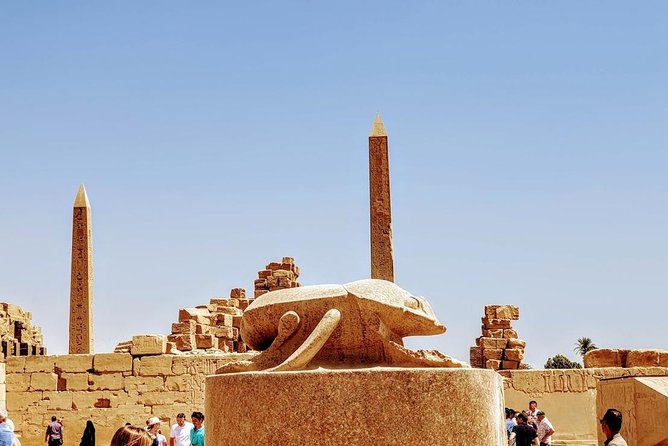
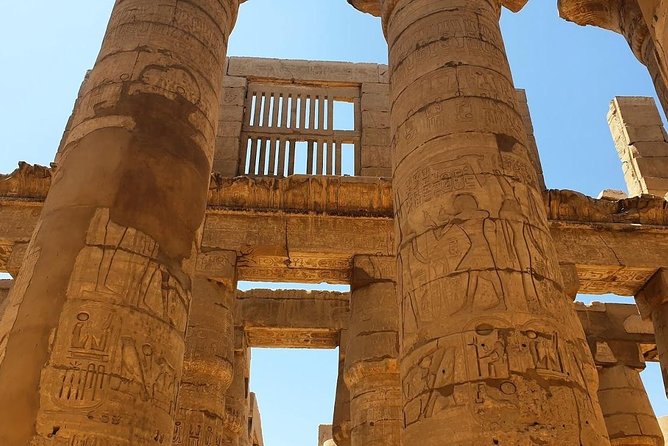
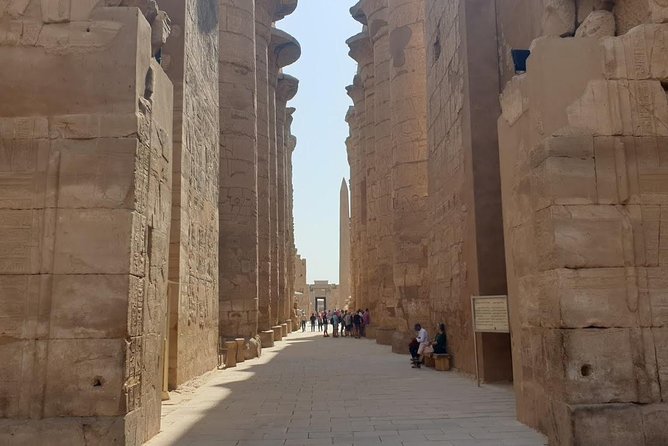
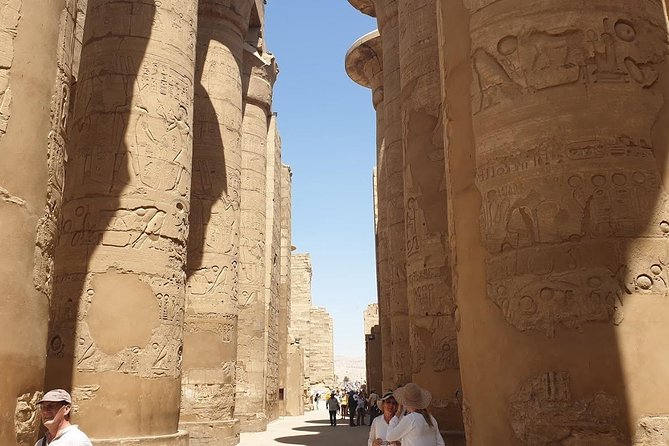
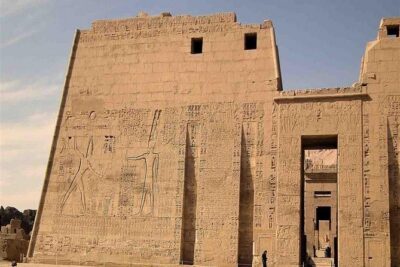
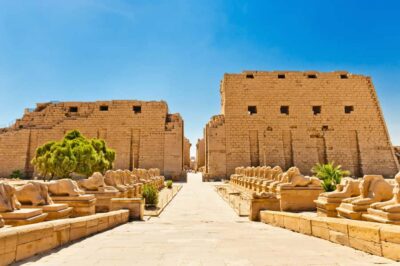
Karnak Temple is your first major stop in Luxor, after the morning drive. Karnak is described as the largest temple complex in Egypt on the east bank of the Nile. That single fact changes how you should approach the site. You cannot treat it like a quick photo spot. It is a complex place with multiple construction areas, and you get value out of a guide who can connect the dots between what you see and what it meant.
You are there for about 2 hours, and entrance is included. That time window is realistic: long enough to absorb the basics, short enough that you do not feel dragged from one stone to the next. Your Egyptologist stays at your side throughout the visit, and that is one of the strongest parts of the experience. It is not just someone talking. It is someone answering your questions while you are still looking at the same structures they are explaining.
If you care about context, Karnak is where your day takes shape. You get the sense of how Luxor functioned as a religious and political center, before you shift gears to tombs in the Valley of the Kings.
Valley of the Kings: 3 tomb chambers and the New Kingdom backstory
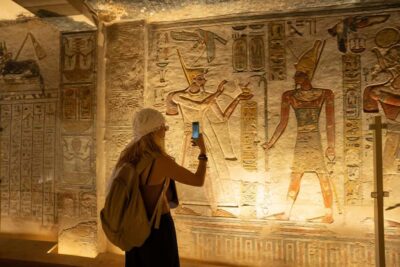
After lunch, you drive about 5 kilometers northwest of Luxor to the Valley of the Kings on the west side. Here the pace usually feels different, because you are no longer in open temple space. You are in the world of rock-cut burial architecture, designed for the long-term story of rulers and their afterlife beliefs.
You get around 2 hours here, and the experience includes visits to 3 burial chambers. That is a big deal for planning. You are not trying to “see everything,” and that is good. The Valley has over 70 graves carved into rock, so a full list day is not the point. The point is to give you a strong, manageable sample of what a New Kingdom tomb environment feels like, with guidance to make it meaningful.
A few facts you will likely hear from your Egyptologist, and they help you understand why certain tombs matter. In ancient Egypt, the Valley of the Kings was known as Sechet-aat, large field. The main royal burials you associate with this place come from the New Empire period, roughly 1550 to 1069 BC, spanning about 18 to 20 dynasties. The story behind the mummies is also part of the narrative: in the 22nd dynasty, mummies were removed from tombs and hidden in other locations to protect them.
Then comes the modern shock of discovery. In 1922, the tomb of Tutankhamun was discovered largely intact. And the idea of systematic searching is tied to early European expeditions, including the period when Napoleon’s expedition to Egypt helped spark more structured interest in tombs and monuments. Hearing that timeline while you stand near burial chambers makes the Valley feel less like a checklist and more like a long chain of events.
One practical consideration
Two hours in the Valley, including 3 burial chambers, means you need to move with the group and stay flexible. If you want maximum time inside every chamber, this format may feel like you are seeing only part of the Valley. But if you want the high-value highlights with explanation, the time allocation fits the day.


Colossi of Memnon: quick, famous, and strangely powerful
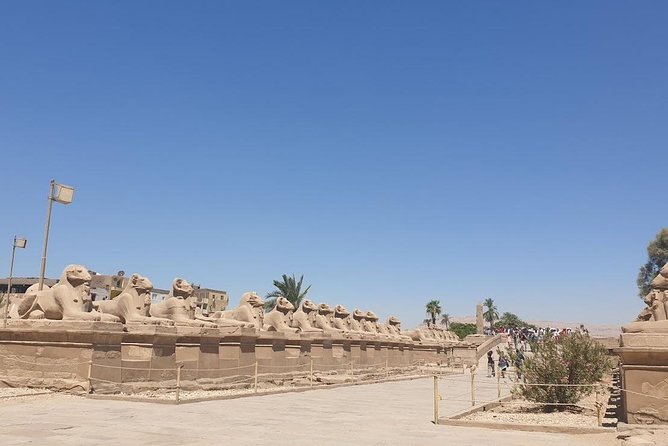
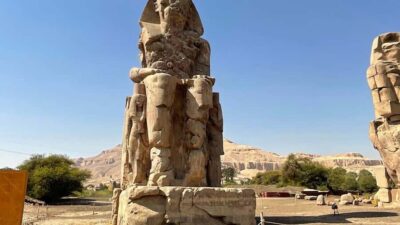
Next comes the Colossi of Memnon, a short stop with big visual impact. These are two adjacent Egyptian colossus statues from the 14th century, representing King Amenophis III. They are still around 18 meters high, including the base, and they face toward the Nile.
These statues have Arabic names, el-Colossat or es-Salomat, and your guide can connect that local identity to how the site has been known across different centuries. You are at this stop for about 10 minutes, and entrance is included. Ten minutes sounds brief, but for the Colossi, that is often perfect. The statues are your moment. You look up, you understand scale, and you move on without dragging the stop into something it is not.
Think of this as your visual palate cleanser between East Thebes and the deeper west bank atmosphere of Hatshepsut. It is also a useful reminder that Luxor is not only temples and tombs. It is monumental statuary meant to broadcast power across time.
Hatshepsut at Deir el Bahari: limestone terraces and a west-bank anchor
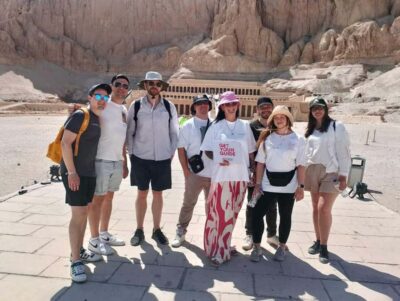
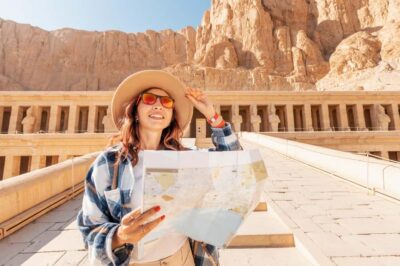
The final major stop is the Temple of Queen Hatshepsut at Deir el Bahari. This is the mortuary temple complex associated with Hatshepsut, who is assigned to Egypt’s 18th dynasty. The dates given for her reign are 1479 to 1458 BC, and her spouse was Thutmoses II.
Your guide will likely explain the meaning behind her name: Hatshepsut means The first of the noble women who embraced Amun. Even if you are not memorizing dates, that detail helps you connect the person to the place. You are not just looking at stone. You are looking at a designed expression of authority and belief.
Construction material matters here. The temple complex is made of limestone, and it is described as the best preserved temple on the west bank in Thebes. That kind of preservation affects your experience. When a site holds up well, the guide can point out relationships between the space, the design, and the story of the ruler that built it.
You start heading back home at around 4:00 p.m., with your return to Hurghada after the west-bank finale. That end time is why this stop works well as the last big monument. You still get the emotional high, but you are not stuck driving in the dark for too long.
What the Egyptologist does for you, and why the small group matters
This tour is designed around a guide who is an Egyptologist. The plan specifically notes that the Egyptologist stays close and is happy to answer questions. That sounds like marketing, but the group size gives it real teeth. Your visit is arranged as a small group, with a maximum of 8 people, and the tour is private in the sense that only your group participates.
In places like Karnak and the Valley of the Kings, questions are not just trivia. They are how you understand what you are looking at. Why a tomb location was chosen. What time period a king belongs to. Why a mortuary temple sits where it does. When you have a smaller group, you can ask those questions without waiting for your turn.
The reviews you will find for this operator repeatedly credit specific guides for German-speaking clarity and archaeological focus. Names that come up include Marian, Ebram Sobhy, Gerges, Naschaat (also written as Nasch), Obi, and Ismail, with Nash mentioned as well. If you are booking and you care about a guide who explains with patience, those names are a good sign to look out for in your assigned guide list.
Drivers also get mentioned for punctuality and smooth handling, including Carlos, Helal, and Mina. Even though the driving is not the main event, punctual pickup and well-managed timing make the whole day feel less stressful.
Lunch, tickets, and the parts people forget to budget for
The tour includes lunch. It does not include drinks in the restaurant, so plan on purchasing beverages separately if you want them. Entrance fees for the listed visits are included, along with all services and local taxes. That matters because tomb visits and major temple complexes can add up quickly once you start piecing tickets together yourself.
You also get mobile ticket support, which is handy if you do not want to juggle paper. In practice, that can save time at entry points, especially when the group is moving on a tight schedule.
So, what is not included? The tour lists personal expenses and any additions not mentioned in the program. That is normal, but it is still worth setting a small budget aside so you do not feel annoyed later.
Price and value: is $221 per person fair for a full Luxor day?
At $221 per person, this is not a budget “see Luxor in 2 hours” type of trip. It is a one-day Luxor run from Hurghada with a long drive, a full Egyptologist-guided route, included lunch, private transportation, and entrance fees.
Here is what makes the value feel more solid than it might look at first glance:
- You get a full sequence of major sites across both banks of the Nile, not just one temple.
- You have guidance for the two highest-information stops: Karnak and the Valley of the Kings.
- You are not paying separate admission for each part of the day, since entrance fees are included for the activities named.
- The small group limit of 8 is a quiet upgrade. It often means you spend less time waiting and more time actually hearing explanations.
If you already planned to hire a guide in Luxor and buy entry tickets, the price starts to make more sense. If you were thinking of doing Luxor independently with a taxi and no structured tomb plan, you would likely spend a lot of effort managing timing, entry, and what to prioritize.
The only “value mismatch” I can see is for people who want maximum time in fewer sites. This schedule is about hitting the best-known Luxor highlights in one day, not about lingering for hours in one tomb.
Timing tips to make the 14-hour day feel manageable
This day trip is long, but you can make it easier with a few habits.
First, treat the early pickup as the main event. If you want to enjoy Karnak and the Valley without feeling wrecked, you need sleep and hydration. Start the day with water, not just caffeine.
Second, plan for heat and sun exposure. Even if the itinerary does not specify weather gear, your stops are outdoors at least part of the time, especially at Karnak and around the Colossi and terraces at Deir el Bahari.
Third, keep your expectations matched to the schedule. The Valley of the Kings visit includes 3 burial chambers in about 2 hours. That means you will not have unlimited time inside every tomb area. Go in ready to learn, not to “win” the day with the most minutes.
Finally, remember the lunch is included, and drinks are not. If you are the type who gets cranky without a specific beverage, plan ahead so lunch stays pleasant instead of annoying.
Should you book this Hurghada to Luxor day trip?
Book it if you want a guided, structured Luxor day that covers East Thebes temples and the west bank tomb and mortuary landscape in one go. The early 5:00 a.m. start, the small group up to 8, and the Egyptologist-led explanation are the biggest reasons to choose this over a DIY day.
Skip it or consider a different format if you cannot handle a long 14-hour day or you strongly prefer slower museum-style visiting. This is a classic “best highlights, guided, all in one day” approach.
If you do book, lean into what the tour is good at: asking questions while you are looking at the sites, taking your time with the narrative, and letting the day’s order make sense. Luxor is easier to enjoy when you understand what each stop contributes to the larger story.
FAQ
What time will I be picked up from Hurghada?
Pickup is arranged for around 5:00 a.m., and you travel to Luxor in a comfortable, air-conditioned vehicle.
How long is the Luxor day tour?
The duration is listed as approximately 14 hours.
Is lunch included, and are drinks included?
Lunch is included. Drinks in the restaurant are not included.
What does the tour include in the Valley of the Kings?
The tour includes visits to 3 burial chambers in the Valley of the Kings.
Are entrance fees included for the sites?
Yes. Entrance fees for the listed activities are included.
How big is the group?
The excursion is described as a small group with a maximum of 8 people, and it is private for your group.
Does the tour use mobile tickets?
Yes, mobile ticket is listed as a feature.
What happens if the weather is bad or I need to cancel?
The experience requires good weather, and if it is canceled due to poor weather you will be offered a different date or a full refund. You can cancel up to 24 hours in advance for a full refund.
Down Into the Kings Valley



More of Hurghada from our review pile
- From Hurghada: El Gouna Quad and MX Bike Safari Tour
★ 4.5 · 25 reviews - Super Safari ( Jeep – Quad- Buggy car-folklore-BBQ dinner)
★ 5.0 · 26 reviews - Private Tour: shopping Tour In Hurghada
★ 5.0 · 26 reviews - Private Speedboat Tour From Hurghada
★ 5.0 · 26 reviews - Orange Bay Island By Speedboat
★ 5.0 · 26 reviews - Orange Bay Island Boat Trip and Parasailing with Lunch – Hurghada
★ 5.0 · 26 reviews
Valley of the Kings & King Tut Tombs, compared.
 ★ 4.7Luxor Valley of the Kings & Tutankhamun Tomb TripFrom $7613,208 reviews
 ★ 4.8Luxor Day Trip from Hurghada Small Group & Tutankhamun TombFrom $955,366 reviews
 ★ 4.5Small group Hurghada to Luxor, Valley of the Kings by VanFrom $352,470 reviews
 ★ 5.0Luxor Day Tour: Valley of Kings & Queens & Hatchepsut TemplesFrom $891,496 reviews
 ★ 4.4Valley of the Kings and Hatshepsut Temple Day TourFrom $501,404 reviews
 ★ 4.6Luxor Tour with Valley of Kings, Karnak & Tut TombFrom $1031,082 reviews
 ★ 4.6Small-Group Luxor Highlights & Tut Tomb Day TourFrom $105928 reviews
 ★ 4.7Luxor Highlights & King Tut Tomb Tour with LunchFrom $150902 reviews
The lists this one sits on