
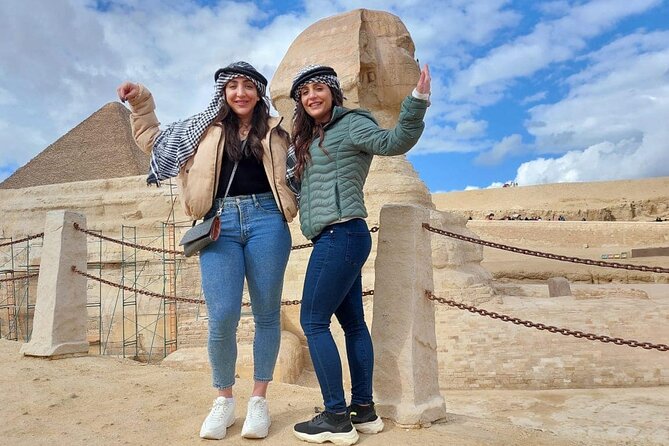
REVIEW · GIZA PYRAMIDS & SPHINX TOURS
Tour Giza pyramids,Sphinx,Sakkara Pyramid,Memphis& Pyramid Inside
The pyramids are still the main event, even in a crowd. This 8-hour private day tour strings together Giza, Saqqara, Memphis ruins, and multiple pyramid stops with an Egyptologist guiding the story all day. I like the way it gives you classic “hit the highlights” momentum without losing the historical thread.
Two things I particularly like: the private guide and round-trip hotel transfers that keep your day running smoothly. And I also like that the plan leaves room for a lunch or bazaar stop, so you are not stuck in a pure sightseeing robot loop the whole day.
One thing to keep in mind: many entrances are not listed as included, so you should budget for ticket fees at several stops, plus any optional extras that can come up along the way.
In This Review
- Key highlights worth your attention
- A value-priced Cairo day built around four pyramid zones
- Pickup, private transport, and why timing matters at Giza
- Giza Plateau: the classic start, plus panoramic viewpoint time
- Great Pyramid of Khufu: the stop that turns the day into a real memory
- Khafre, Menkaure, and the quick pyramid contrast you can actually feel
- The Sphinx area: not just a statue, a whole visual anchor
- Memphis and the Sphinx of Memphis: where the story shifts to an older capital
- Saqqara: the necropolis that makes you see the pyramid idea evolve
- The Dashur and Red Pyramid question you should confirm
- Lunch and local bazaar time, when it helps
- Tickets, entrance fees, and why $19 needs a reality check
- Guide quality, Bishoy and Hesham, and the best way to avoid surprise extras
- Who should book this tour
- Should you book this Giza, Saqqara, Memphis, and pyramid-inside day tour?
- FAQ
- How long is the tour?
- Is hotel pickup and drop-off included?
- Is this tour private?
- Are admission tickets included for all sites?
- Do you provide mobile tickets?
- Is there an extra cost for some pickup areas?
- What is the cancellation policy?
Key highlights worth your attention
- Private car plus pickup and drop-off make this feel efficient, not exhausting.
- Giza first, then the rest of the pyramid world in one long day.
- Great Pyramid timing includes an inside experience option (one key highlight from the feedback).
- Saqqara features both Teti and Djoser so you get more than one “wow” moment.
- Memphis and the Sphinx of Memphis shift you from famous plateau legends to an older capital.
- The itinerary includes photo-friendly viewpoints, including a guide-guided spot for pictures.
Ways onto the Giza plateau, compared
- Cairo: Pyramids & Great Sphinx Private Tour with Camel Ride★ 4.9 · 6,335 reviews
- Tour to Giza Pyramids and The Egyptian Museum★ 5.0 · 6,016 reviews
- VIP All inclusive Best of the best Giza Pyramids,Sakkara,Memphis★ 5.0 · 3,164 reviews
- From Cairo: Pyramids of Giza, Sphinx, Saqqara & Memphis Tour★ 4.7 · 3,110 reviews
A value-priced Cairo day built around four pyramid zones
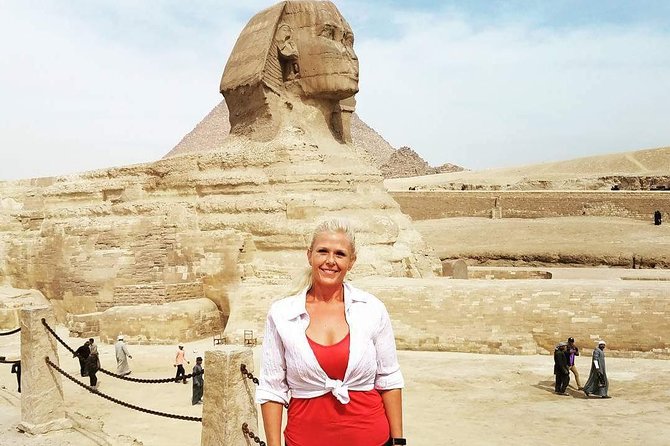
This is a strong “one-day, many sites” format. You start on the Giza Plateau, move through the Sphinx area and additional Giza pyramids, then continue to Memphis and Saqqara. The tour description also calls out Dashur and Sneferu’s Red Pyramid, but the stop list you see depends on how your day is timed, so it is worth confirming what you will actually cover that day.
The headline price is very low for a full day with hotel pickup and private transport. That is usually a clue that the price covers the guide and logistics, not every entrance fee. If you treat it like a guided sightseeing day and plan ticket spending separately, it feels like good value.
Pickup, private transport, and why timing matters at Giza
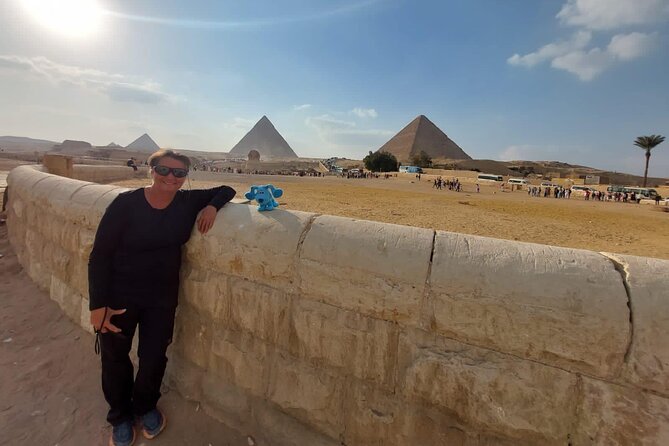
The tour runs about 8 hours, and it is built around hotel pickup and drop-off in Cairo or Giza. You travel by air-conditioned private car, plus bottled water is included. That matters in Egypt, because heat and long waits can turn a great day sour fast.
Private transport also means less time herding around. You are following your guide, not the group schedule, which helps when you want photos, want to adjust for crowds, or want to ask smart questions in the moment.
If you are staying farther out, there is an extra charge for areas like NASR City, 6th October City, and New Settlement area. So if you are near those, factor in that add-on when you compare total cost.
Giza Plateau: the classic start, plus panoramic viewpoint time
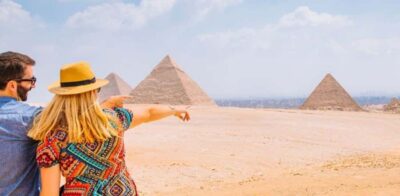
Most days begin with the three major Giza pyramids: Khufu, Khafre, and Menkaure. You get a personal guide and a comfortable ride to the main spots, and then you also get a viewpoint moment for panoramic views of all nine pyramids of Giza silhouetted against the desert sands.
That viewpoint time is not filler. At Giza, it helps you understand what you are looking at. From the right angle, the layout clicks into place: how the pyramids sit on the plateau, how the Sphinx zone fits in, and how the necropolis was planned to dominate the horizon.
A typical itinerary pace here is short at each pyramid. That is a trade-off: you see more sites today, but you will not have the leisurely wandering time you would on a multi-day approach. If you are the type who likes to sit, sketch, or study carvings slowly, you may want to do Giza more than once during your trip.
Great Pyramid of Khufu: the stop that turns the day into a real memory
The Great Pyramid of Khufu is the big one. It is described as the largest Egyptian pyramid, the tomb of Fourth Dynasty pharaoh Khufu, built around the 26th century BC. The tour plan includes a stop tied to entering it, with a note that the admission for this stop is listed as free.
Because the broader structure says admission is not included, I would treat that “free” note as something to confirm at booking. Still, the real-world takeaway from the feedback is clear: people really value the chance to go inside the Great Pyramid, and they connected it to the workout of the stairs and tight interior spaces.
If you are sensitive to confined spaces or you prefer fresh-air breaks, plan ahead. The interior experience can be physically demanding, and the timing is short by design.
Necropolis stops south of the city
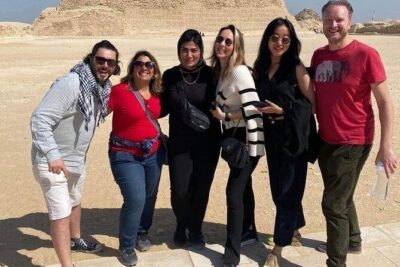
Khafre, Menkaure, and the quick pyramid contrast you can actually feel
After Khufu, the itinerary moves to the pyramid of Khafre and then to Menkaure. These stops are brief, which means the best approach is to use your guide for interpretation, not just sightseeing.
Khafre’s pyramid is noted as second-tallest and second-largest among the three main Giza pyramids. Menkaure’s is the smallest of the main trio. Even in short visits, you can feel the shift in scale, and your guide can point out why that matters to the story of the dynasty and royal burials.
If you want the most bang for your viewing time at Giza, come ready with two questions:
1) What makes each pyramid different in purpose or design?
2) How do those design differences show changing royal priorities?
That turns quick stops into real learning.
The Sphinx area: not just a statue, a whole visual anchor
The Great Sphinx stop is built around a short visit with a guide explanation. A sphinx is described in Greek tradition as having a human head and a lion body, and your guide will likely help you connect myths and real archaeology.
In practice, the Sphinx zone functions like a visual anchor for the whole Giza complex. You understand it best when you see it after the pyramids, because it helps you organize your mental map: pyramids as the tombs, Sphinx as the guardian presence, and the surrounding landscape as the ceremonial approach.
If you are chasing iconic photos, the best advice is simple: ask your guide where the light will look best and where the background stays uncluttered. One guide named Bishoy was specifically praised for taking visitors to a strong picture spot.
Memphis and the Sphinx of Memphis: where the story shifts to an older capital
After Giza, the day changes gears. The tour goes toward Memphis, also called Men-nefer, described as the ancient capital of Inebu-hedj and known as the first nome of Lower Egypt. The ruins are near Mit Rahina, about 20 km south of Giza.
Memphis is valuable because it broadens your perspective beyond “just pyramid tourism.” You start to feel how these sites connect across time, cities, and royal power. Even when the ruins are not as instantly dramatic as Giza, the guide’s explanation helps you see why this place mattered.
You also visit the Sphinx of Memphis, sometimes referred to as the Alabaster Sphinx. It is described as a stone sphinx near the remains of Memphis, with a carving timeframe believed to be between 1700 and 1400 BC during the 18th Dynasty. The exact honored pharaoh is unknown, and the facial features are suggested to imply Hatshepsut or Amenhotep II.
That uncertainty is part of what makes the stop interesting. It is not everything spelled out for you, so you rely on your guide to connect clues and context.
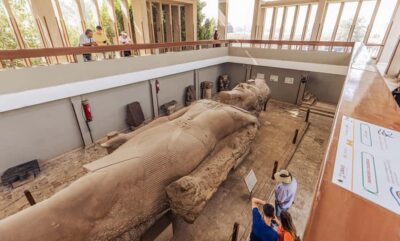
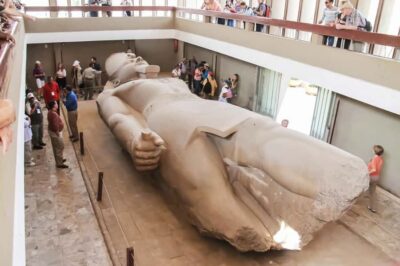
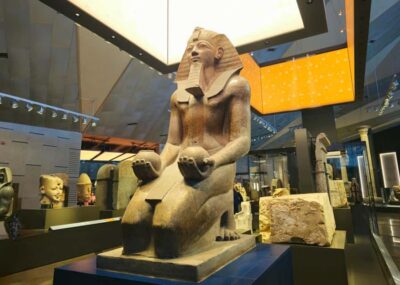
There is also a stop listed for a statue of Ramses II near the Grand Egyptian Museum area. It is described as a 20-minute stop, with admission not included. Think of it more as a photo and context pause than a ticketed museum visit.
Saqqara: the necropolis that makes you see the pyramid idea evolve
Saqqara is where the tour really earns its name as more than a checklist. It is described as a burial ground of Egyptian royalty and the necropolis serving the ancient capital Memphis. You will get multiple pyramid-related stops, including Teti and Djoser.
The tour also lists the pyramid of Teti. It is described as a smooth-sided pyramid and noted as the second known pyramid containing pyramid texts. You also have mentions of nearby satellite pyramid structures and queen pyramids. Even if you only see parts of the complex, your guide can help translate what you are looking at into “what it meant” for the burial system.
Then comes the Step Pyramid of Djoser. This is the “earliest colossal stone building in Egypt” in the tour description, built in the 27th century BC in the Third Dynasty. The Step Pyramid’s six-tier design is a major visual lesson: it shows evolution toward the later true smooth-sided pyramid forms.
This is the moment where I like the one-day plan most. You go from monuments that look finished and famous, to monuments that look like deliberate experimentation. That makes the day feel like a timeline, not just a parade.
The Dashur and Red Pyramid question you should confirm
The tour overview says you will visit the necropolis of Dashur, home to Sneferu’s Red Pyramid. However, the stop list you receive in your itinerary view does not explicitly show a Dashur stop the way it does for Saqqara and Memphis.
So here is my practical advice: before you commit your full day schedule, ask the operator or your guide what your actual Dashur coverage will be that day. You want clarity on whether you will get Sneferu’s Red Pyramid time or if the day is adjusted toward the Saqqara and Giza concentration.
This is also a good reason to pay attention to the day-of flow with your guide. Private tours can shift with traffic, priorities, or how entrance times work.
Lunch and local bazaar time, when it helps
The tour description mentions an optional lunch stop or time to shop at a local bazaar. On paper, that sounds like a minor add-on. In reality, it can be the difference between a day that feels manageable and one that feels like sprinting.
Egypt in summer can be brutal. Having even one pause where you can eat and cool down makes the rest of the monuments feel easier to enjoy. Shopping time can also work if you want simple souvenirs, but only if it does not hijack your pyramid time.
If you do shop, set a budget before you walk in. It keeps you from getting surprised later, and it keeps your guide time focused on what you came for.
Tickets, entrance fees, and why $19 needs a reality check
The listed price is $19 per person. That is shockingly low for a private day with an Egyptologist and air-conditioned transportation. The likely reason is that entrance fees are mostly not included, and the tour notes admission ticket status case by case.
For example, the Great Pyramid stop is marked as admission ticket free in the plan you were given. Other pyramid entries are marked as not included, including Pyramid of Khafre and Pyramid of Menkaure. Saqqara sites like the Pyramid of Teti and the Step Pyramid of Djoser are also listed as not included.
So when you estimate total spending, treat the tour price as the core service fee, then add expected ticket fees where indicated. If you also want “inside” time at additional monuments, you may need extra payments depending on what is open and what is offered for your day.
If you get a surprise ask for extra payments during the tour, do not panic. Just ask what is included, what the ticket covers, and whether it is optional.
Guide quality, Bishoy and Hesham, and the best way to avoid surprise extras
The feedback includes two guide names. Hesham is listed as the Egypt tour guide responding to reviews, and Bishoy is specifically credited for taking visitors to a good picture spot. That tells me the guide experience is not just a checkbox here. You can get real value from someone who knows where to stand and what to explain in the right order.
The other review includes a caution. The complaint was about being overcharged on extra parts of the tour, with advice to question additional charges. I agree with that advice.
Here is how to handle it smartly:
- Ask what is included before you pay for anything extra.
- Request the price breakdown for each added stop.
- If it is optional, confirm you can skip it without affecting the rest of the day.
A good guide should welcome these questions, because it keeps you comfortable and keeps the day on track.
Who should book this tour
This fits best if you want a concentrated day that hits major pyramid zones: Giza, Sphinx, Memphis, and Saqqara. If you are staying in Cairo or near Giza and you only have one day to prioritize monuments, this format is practical.
It is also a good fit for people who like guidance. Short stop times can feel rushed if you are wandering alone. An Egyptologist helps you turn those quick looks into meaning, so the day feels worth it even when each site is brief.
On the other hand, if you want long stays, minimal ticket hassle, or a more relaxed pace where you can linger and study, you may prefer a slower itinerary over multiple days.
Should you book this Giza, Saqqara, Memphis, and pyramid-inside day tour?
I would book it if your goal is clear: see multiple top sites in one day, use a private guide to make sense of what you are seeing, and you are okay planning for entrance fees beyond the tour price. The best value here comes when you show up with realistic expectations, bring water and sun protection, and treat the guide as your navigator.
Skip the “book it blind” approach. Instead, confirm what parts of Dashur are actually covered, verify the admission details for any “inside” portion, and ask for a clear statement of what you will pay for during the day.
If you do that, you will get a memorable, efficient day that connects Giza, Memphis, and Saqqara into one coherent arc of ancient Egypt.
FAQ
How long is the tour?
The tour duration is listed as about 8 hours.
Is hotel pickup and drop-off included?
Yes, hotel pickup and drop-off are included, and the tour also uses an air-conditioned vehicle with bottled water.
Is this tour private?
Yes, it is a private tour, and only your group participates.
Are admission tickets included for all sites?
No. The tour notes that admission tickets are generally not included, with specific stops marked as free or not free. You should expect to pay entry fees at some sites.
Do you provide mobile tickets?
Yes, mobile tickets are listed as a feature of the experience.
Is there an extra cost for some pickup areas?
Yes. Airport and hotels within NASR City, 6th October City, and New Settlement area have an additional charge of $30.
What is the cancellation policy?
Free cancellation is available. You can cancel up to 24 hours in advance for a full refund. If you cancel less than 24 hours before the start time, no refund is provided.
South to Saqqara and Dahshur
Giza, A Few More Ways In

More of Cairo from our review pile
- Cairo Layover Tour to Giza Pyramids Egyptian Museum and Khan Khalili Bazaar
★ 5.0 · 25 reviews - Private Luxor Day tour from Cairo by Flight
★ 5.0 · 25 reviews - Private full day tour to Giza Pyramids, Sphinx, Sakkara and Dahshour with guided
★ 5.0 · 25 reviews - Nile Dinner Cruise in Cairo With Belly Dancing and Transfer
★ 5.0 · 25 reviews - Private Giza Pyramids,Sphinx,camel,lunch, 2 tombs,Great Pyramid
★ 5.0 · 25 reviews - All inclusive Giza Pyramids ,Sphinx ,Lunch ,Camel&Inside pyramid
★ 5.0 · 25 reviews
Giza Pyramids & Sphinx Tours, compared.
 ★ 4.9Pyramids & Great Sphinx Private Tour with Camel RideFrom $486,335 reviews
 ★ 5.0Tour to Giza Pyramids and The Egyptian MuseumFrom $1556,016 reviews
 ★ 4.7Pyramids of Giza, Sphinx, Saqqara & Memphis TourFrom $903,110 reviews
 ★ 4.6Half-Day Tour to Pyramids of Giza and the SphinxFrom $502,891 reviews
 ★ 4.6Pyramids, Sakkara & Memphis Tour with LunchFrom $602,493 reviews
 ★ 5.0Private ViP all-inclusive Giza Pyramids,Sphinx,Inside PyramidFrom $142,448 reviews
 ★ 4.7Grand Egyptian Museum, Pyramids, Sphinx Tour & LunchFrom $892,282 reviews
 ★ 4.7Cairo Pyramids, Sphinx & Egyptian Museum Day TripFrom $932,271 reviews
The lists this one sits on