
REVIEW · GIZA PYRAMIDS & SPHINX TOURS
Half Day Tour To Memphis ,Sakkara & Dahshur Pyramids with lunch
Old pyramids, fast. This half-day Cairo tour strings together Saqqara, Memphis, and Dahshur so you see the evolution of pyramid building without spending a full day on the road. What I like most is how the Egyptologist guide ties the monuments to names and myths, like Imhotep and the rulers behind Dahshur. I also like the way you get an extra cultural stop at a local carpet-making school on the return drive.
One drawback to plan for: admission tickets and site entry costs are not included, so you’ll want to budget for that separately, and you may notice the usual on-site selling or tipping requests at popular ruins.
In This Review
- Key Points Before You Go
- A Quick Cairo Escape That Still Feels Full
- Saqqara Step Pyramid, Imhotep, and the Old Kingdom Story
- What you’ll like here
- A consideration
- Inside the Pyramid of Teti and Nearby Tombs
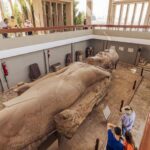
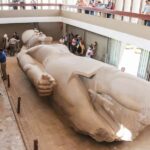
- Memphis Open-Air Museum: Ramses II and the Alabaster Sphinx
- What you’ll like here
- A consideration
- Dahshur Bent Pyramid and Red Pyramid, with Snofru Context
- What you’ll like here
- A consideration
- The Carpet School Stop: Learning Crafts, Not Just Ruins
- Timing, Transport, and How the Day Really Flows
- Price and What You Might Need to Pay Extra
- Guides, Communication, and the Human Side of the Trip
- Who Should Book This Half-Day Pyramid Route
- Should You Book It?
- FAQ
- How long is the tour?
- Is hotel pickup and drop-off included?
- Is the tour private?
- Are entrance tickets included for the sites?
- Is lunch included?
- Do I need cash for anything extra?
- What is the cancellation policy?
Key Points Before You Go
- Hotel pickup and drop-off makes this one of the easiest ways to reach Saqqara and Dahshur from Cairo
- Saqqara highlights include the Step Pyramid, the Pyramid of Teti, and nearby monuments like private tombs
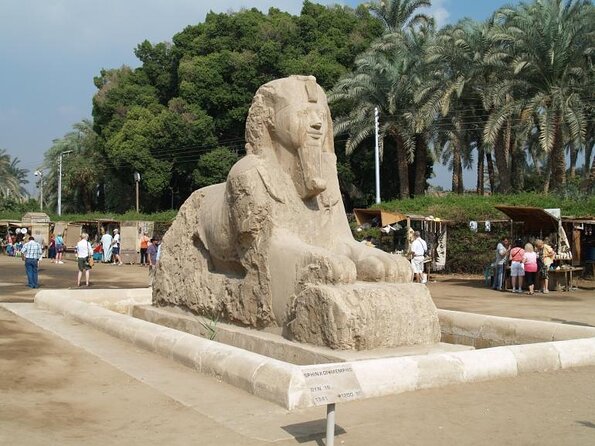
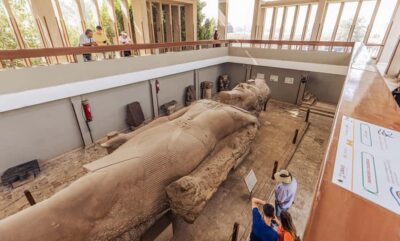
- Memphis open-air museum time focuses on big landmarks, including the Ramses II Colossus and the Alabaster Sphinx
- Dahshur without rushing takes in both the Bent and Red pyramids with context on Snofru and Cheops
- Carpet school stop lets you see children weaving traditional Egyptian carpet designs and wall hangings
- A mobile ticket is provided, which helps keep things straightforward once you’re in Egypt
Ways onto the Giza plateau, compared
- Cairo: Pyramids & Great Sphinx Private Tour with Camel Ride★ 4.9 · 6,335 reviews
- Tour to Giza Pyramids and The Egyptian Museum★ 5.0 · 6,016 reviews
- VIP All inclusive Best of the best Giza Pyramids,Sakkara,Memphis★ 5.0 · 3,164 reviews
- From Cairo: Pyramids of Giza, Sphinx, Saqqara & Memphis Tour★ 4.7 · 3,110 reviews
A Quick Cairo Escape That Still Feels Full
This is a classic Cairo day-burst. You leave the city in an air-conditioned vehicle, you get a guide who can explain what you’re looking at, and you come back the same day. The whole plan runs about 6 hours, so it works well when you want pyramid time but you do not want to lose your entire day to traffic and logistics.
For me, the value is in the mix. Saqqara gives you Old Kingdom origins. Memphis shows how later Egypt handled royal power and monumental display. Dahshur closes the loop by showing different pyramid styles, including the Bent Pyramid and the Red Pyramid. The carpet school stop is not just a side quest either. It is a reminder that Egypt’s crafts are alive, not frozen behind glass.
You also get something practical: bottled water and private transport with hotel pickup and drop-off. That matters in Cairo, where getting to the right road at the right time can make or break a day trip.
Saqqara Step Pyramid, Imhotep, and the Old Kingdom Story
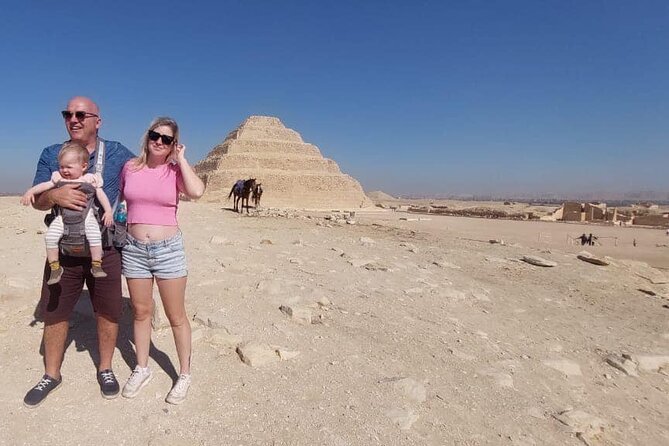
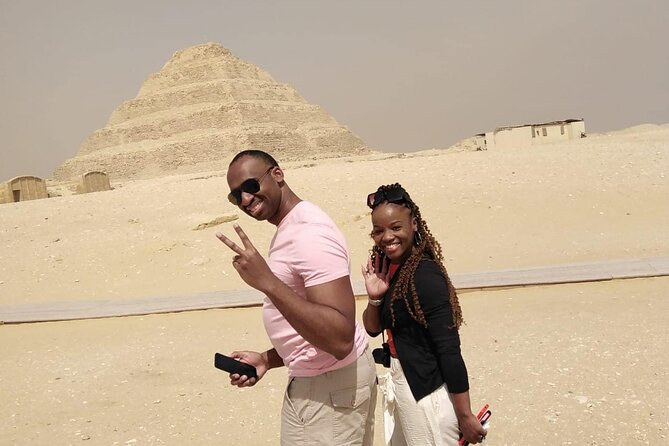
Your first site is Saqqara, where you drive out into the countryside and start with the big visual anchor, the Step Pyramid. This is the first pyramid style built in the area and one of those places where the stones look simpler than later pyramids, but the ambition is obvious. Your guide explains how it connects to Imhotep, the architect figure tied to this breakthrough phase of Egyptian building.
You also get time to move beyond the main pyramid. After the Step Pyramid area, your visit continues with a look at the Pyramid of Teti, plus nearby features such as inscribed texts and private tombs. Even if you are not the type to memorize dynasties, this is the part of the day where the guide’s narrative really helps you “read” the ruins instead of just photographing them.
Practical reality check: the Saqqara grounds take time to walk, and you will be in open-air areas. So if you are sensitive to heat, plan your best water habits, sun protection, and pacing. The tour includes bottled water, but I always treat that as a floor, not a full hydration plan.
What you’ll like here
- You get the origin story of pyramid-building rather than only the famous later forms
- The guide’s focus on Imhotep makes the Step Pyramid more than a shape in the sand
A consideration
- The timing is tight. You will have enough time for key areas, but this is not a slow, in-depth Saqqara wander.
Necropolis stops south of the city
Inside the Pyramid of Teti and Nearby Tombs
The tour includes a focused stop at the Pyramid of Teti. The schedule calls for about 20 minutes here, which means you should use that time deliberately. You are there to understand how this pyramid functions as a royal resting place and to take in the sense of the Old Kingdom layout as you move through chambers and corridors, plus the surrounding inscribed texts.
This is also where a good guide makes a noticeable difference. If your guide talks through what the inscriptions were meant to do and how the spaces were arranged, those quick minutes start to feel worthwhile instead of rushed.
One more thing: the itinerary mentions private tombs in the Saqqara portion, so you are not only seeing one monument. You’re seeing a small cluster of history tied to that royal neighborhood. That can help you understand why Saqqara stayed important long after the Step Pyramid was built.
Memphis Open-Air Museum: Ramses II and the Alabaster Sphinx
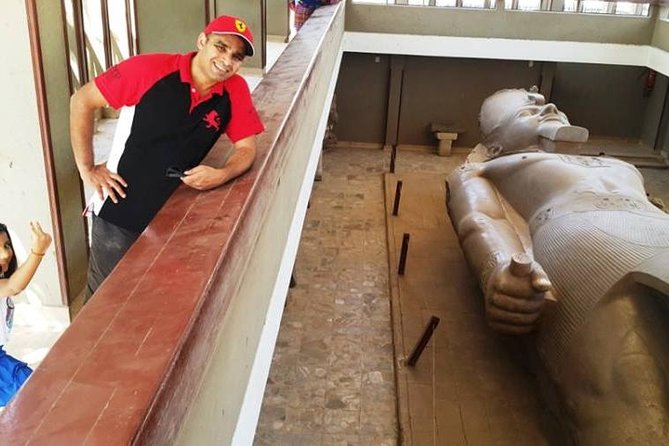
After the pyramid zones, the day shifts gears to Memphis, where you visit the open-air museum. This is a nice change of pace because it is less about climbing pyramid angles and more about standing near famous pieces that survived time and translation.
You’re looking for specific big hitters:
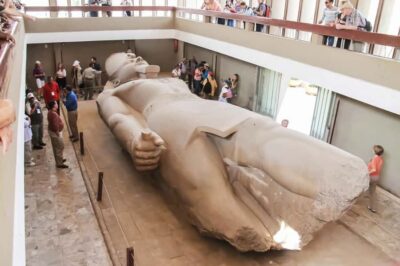
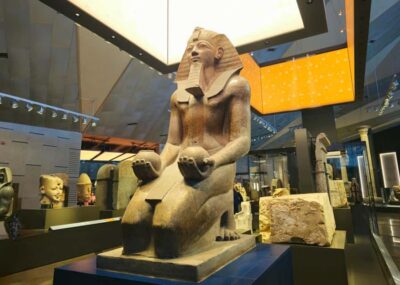
- The Colossus of Ramses II, described as the largest statue of Ramses the Great seen where it was discovered
- The Alabaster Sphinx
This stop is about 30 minutes. That is enough time to get the main points, but not enough time to turn it into a museum day. If what you want is a long, art-object style museum experience, you might find this portion feels short. Still, it is a smart use of time because the “memorial power” of Memphis hits quickly.
Also keep your expectations realistic. Open-air museum areas can feel more like a ruin site with display fragments than like a curated indoor museum. That said, seeing the Ramses II monument in its discovery context helps you connect the objects to place.
What you’ll like here
- The chance to see major royal statuary, especially the Ramses II Colossus
- A break from pyramid walking
A consideration
- If you are expecting a full museum with deep galleries, the short time allocation may not satisfy.
Dahshur Bent Pyramid and Red Pyramid, with Snofru Context
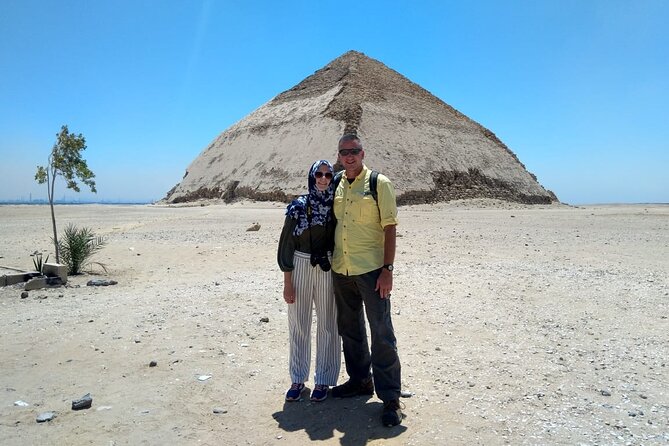
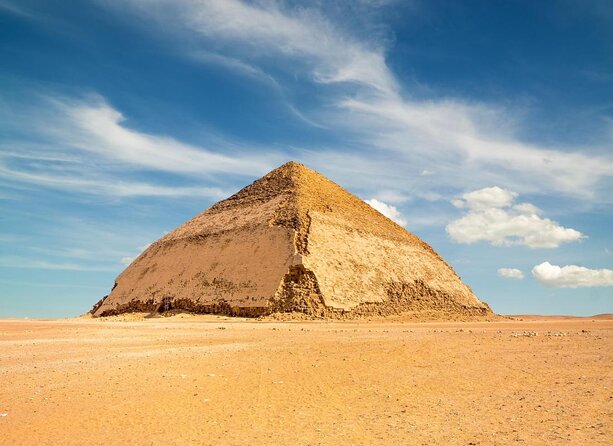
Dahshur is where the day turns into “how did they change the design?” You stop at the Bent Pyramid and also see the Red Pyramid. The itinerary places these pyramids about 2 km south of the Mastaba Faraoun, and it links their construction to the 4th Dynasty king Snofru, described as the first ruler of that dynasty.
The guide’s context matters here. You’re not only looking at an odd shape and thinking, “Why is it bent?” You’re hearing that the change connects to building experiments in the early pyramid era. The itinerary also notes that Snofru may have built another pyramid at Maidoun, and that his son Cheops continued constructive tendencies. Even if you only catch parts of that storyline, it gives you a framework for why Dahshur feels different from Saqqara.
This is the part of the day where you should take your photos early and then linger a little. The pyramids can look better from multiple angles, and the sky and sun make a big difference in how the stone tones show up. Since you only have about 1 hour for the final stop segment (including the route back), make sure you do not burn your time at a single viewpoint.
What you’ll like here
- You see two major Dahshur forms in one go, the Bent and Red pyramids
- The guide’s explanations connect shape to dynasty and experimentation
A consideration
- It is still a half-day. You will see the highlights, not every angle, corridor, or surrounding detail.
The Carpet School Stop: Learning Crafts, Not Just Ruins
On the way back to Cairo, the tour includes a bonus stop at a local carpet-making school. The itinerary specifically says you’ll see children weaving carpets and wall hangings, and that this is a traditional skill passed on through education.
This stop is a big reason the tour feels more human than a straight ruin-hopping itinerary. Pyramids tell one story. A carpet school tells another: how daily life and cultural skills continue. It also gives you a break from the monument focus right when your legs might be starting to feel the day.
I like these stops because they are usually short but memorable. You can watch real work in progress, ask simple questions if you’re able, and leave with a sense of the living side of Egypt.
Timing, Transport, and How the Day Really Flows
From start to finish, the rhythm is straightforward. You start with hotel pickup, drive out to Saqqara, spend time at Step Pyramid and surrounding Saqqara sites, then shift to Memphis, and finish with Dahshur plus the carpet school stop before returning to your hotel.
The tour runs for about 6 hours total. That makes it a good fit for:
- People staying in Cairo who want pyramid highlights without committing to a full day
- First-timers who need an organized route with a guide to interpret what they see
- Travelers who appreciate a mix of ancient sites and a glimpse of modern craft life
What helps a lot is that it is private, meaning it is only your group. That reduces the usual stress of waiting for large crowds to shuffle between stops.
You’ll also have a mobile ticket, which typically makes meeting up and confirming details easier once you’re on the ground.
Price and What You Might Need to Pay Extra
The headline price is $19 per person, which is low enough to make you do a quick reality check. The key detail is that admission tickets are not included. That is where a chunk of your actual cost may land depending on the site entry fees required on the day you travel.
The tour includes:
- Hotel pickup and drop-off
- Private transport
- Bottled water
- Taxes, fees, and handling charges
- All taxes, fees and handling charges are included, which helps reduce surprises
There’s also an extra note about certain pickup areas. If your pickup location is in specific areas like 6th October city, new settlement, ring road, Nasr City, an airport, or its nearby hotels, the information says there is a surrounding $30 cash cost. So if you are not staying near central Cairo, confirm your pickup zone early.
One more small practical point: lunch is described in the tour title as included. The inclusions list here does not explicitly call out lunch, so I’d treat it as “advertised as part of the package” and verify with the provider message. That is an easy check that can save you confusion later.
Guides, Communication, and the Human Side of the Trip
The experience is led by an Egyptologist guide, which is what you want for places like Saqqara and Dahshur, where names and building choices matter. The guide is there to give the background on pyramids, architects, and mythology tied to the monuments.
In particular, several guides and drivers are named in the experiences shared with the operator, including Samir, Magdy, Bishoo, and Ehab. The common theme is clear communication in English, friendly handling, and enough time at the sites so you can actually look rather than speed-run history.
There is also evidence of responsiveness when plans change. One account described a delayed flight and the guide working to accommodate a new pickup point. That kind of flexibility is not guaranteed for every day, but it is a comfort signal if your travel schedule is tight.
Who Should Book This Half-Day Pyramid Route
This tour is best for you if:
- You want a fast, organized pyramid day without building a DIY itinerary
- You prefer a guide who explains who built what and why the pyramids look the way they do
- You like seeing at least one modern cultural stop, like the carpet school
- You are traveling as a group and can benefit from the operator’s stated group discounts
It may not be ideal if:
- You want deep, slow museum time at Memphis rather than a short, highlight-focused visit
- You dislike on-site selling or tipping requests. Some ruins areas can be pushy, and that can affect how much you enjoy the stop
If you are sensitive to that, I’d set your personal boundaries early, keep your interactions short, and focus your attention on the guide’s explanations so you stay in the history mode.
Should You Book It?
I’d book this tour if you want a high-yield half-day built around Saqqara and Dahshur, plus a short cultural stop that makes the day feel less like a checklist. The hotel pickup, private vehicle, and Egyptologist guidance are what make it practical and worth the time, especially if you are new to Cairo.
Just go in with one clear plan: bring money for admissions, double-check lunch inclusion with your confirmation message, and be ready for the short time at each stop. If you do that, you’ll leave with a stronger sense of how Egyptian pyramid ideas evolved, and you’ll have seen a living tradition in the carpet school before heading back to the city.
FAQ
How long is the tour?
The tour is about 6 hours (approx.).
Is hotel pickup and drop-off included?
Yes, hotel pickup and drop-off are included.
Is the tour private?
Yes, it is a private tour, meaning only your group participates.
Are entrance tickets included for the sites?
No. Admission tickets are not included for the listed stops.
Is lunch included?
Lunch is mentioned in the tour title. The inclusions list provided does not spell out lunch separately, so it is worth confirming during booking.
Do I need cash for anything extra?
Admission tickets are not included, and some pickup locations may require an extra $30 cash charge (6th October city, new settlement, ring road, Nasr City, airport and its hotel and surrounding areas).
What is the cancellation policy?
Free cancellation is available if you cancel up to 24 hours in advance for a full refund.
South to Saqqara and Dahshur

Giza, A Few More Ways In


More of Cairo from our review pile
- Cairo Layover Tour to Giza Pyramids Egyptian Museum and Khan Khalili Bazaar
★ 5.0 · 25 reviews - Private Luxor Day tour from Cairo by Flight
★ 5.0 · 25 reviews - Private full day tour to Giza Pyramids, Sphinx, Sakkara and Dahshour with guided
★ 5.0 · 25 reviews - Nile Dinner Cruise in Cairo With Belly Dancing and Transfer
★ 5.0 · 25 reviews - Private Giza Pyramids,Sphinx,camel,lunch, 2 tombs,Great Pyramid
★ 5.0 · 25 reviews - All inclusive Giza Pyramids ,Sphinx ,Lunch ,Camel&Inside pyramid
★ 5.0 · 25 reviews
Giza Pyramids & Sphinx Tours, compared.
 ★ 4.9Pyramids & Great Sphinx Private Tour with Camel RideFrom $486,335 reviews
 ★ 5.0Tour to Giza Pyramids and The Egyptian MuseumFrom $1556,016 reviews
 ★ 4.7Pyramids of Giza, Sphinx, Saqqara & Memphis TourFrom $903,110 reviews
 ★ 4.6Half-Day Tour to Pyramids of Giza and the SphinxFrom $502,891 reviews
 ★ 4.6Pyramids, Sakkara & Memphis Tour with LunchFrom $602,493 reviews
 ★ 5.0Private ViP all-inclusive Giza Pyramids,Sphinx,Inside PyramidFrom $142,448 reviews
 ★ 4.7Grand Egyptian Museum, Pyramids, Sphinx Tour & LunchFrom $892,282 reviews
 ★ 4.7Cairo Pyramids, Sphinx & Egyptian Museum Day TripFrom $932,271 reviews
The lists this one sits on