
REVIEW · GIZA PYRAMIDS & SPHINX TOURS
Full Day Tour to Giza Pyramids with Camel Ride and Egyptian Museum in Cairo
Camel rides and pyramids in one day sounds simple. This affordable Cairo outing ties together the big-ticket sights of Giza and a focused visit to the Egyptian Museum, with hotel pickup, air-conditioned driving, and a short camel ride to break up the sightseeing rhythm. I especially like how the day is built for first-timers, you hit the Sphinx area and more than one pyramid, then you switch to museum galleries where you can slow down and connect objects to what you just saw.
Two standouts: the convenience of hotel pickup and drop-off, and the value of seeing multiple pyramid monuments in one go instead of cherry-picking just one. One thing to consider is that entry fees are described as basic area only, and entrance costs can vary by tour options, so you should confirm what is already included before you assume everything is covered.
In This Review
- Key takeaways before you go
- The Real Value of a $8 Giza and Museum Day
- Hotel Pickup and AC Transit: Your Time Saver in Cairo
- The Giza Plateau Morning: Getting Your Bearings Fast
- Cheops Pyramid to Khafre Pyramid: Three Stops, Three Scales
- The Great Sphinx: Where History Meets a Big Question
- Camel Ride Time: Short, Built In, and Usually the Fun Part
- Egyptian Museum in Cairo: Why This Stop Makes the Day Click
- Timing, Lunch, and Energy: Keep a Simple Plan
- Price and Logistics: What You Pay, What You Don’t
- Guide Quality: The One Variable You Can Control
- Who Should Book This Tour
- Should You Book This Full Day Giza Tour?
- FAQ
- What time does the tour start?
- How long is the full day tour?
- Is hotel pickup and drop-off included?
- Is there a camel ride included, and how long is it?
- Is bottled water or snacks provided?
- What does the Egyptian Museum visit include?
- Are entry fees included?
- Is lunch included?
- Is this tour private?
- Can I cancel for a full refund?
Key takeaways before you go
- Hotel pickup and AC transfers help you dodge Cairo traffic stress
- Giza Plateau timing gives you a real block of time, about 3 hours in the complex area
- Short camel ride is built in for about 30 minutes, so it stays manageable
- Egyptian Museum highlights include the King Tut exhibit and the Rosetta Stone
- Admission depends on your option beyond basic area access, so double-check fees
Ways onto the Giza plateau, compared
- Cairo: Pyramids & Great Sphinx Private Tour with Camel Ride★ 4.9 · 6,335 reviews
- Tour to Giza Pyramids and The Egyptian Museum★ 5.0 · 6,016 reviews
- VIP All inclusive Best of the best Giza Pyramids,Sakkara,Memphis★ 5.0 · 3,164 reviews
- From Cairo: Pyramids of Giza, Sphinx, Saqqara & Memphis Tour★ 4.7 · 3,110 reviews
The Real Value of a $8 Giza and Museum Day
Let’s talk value first, because this is priced at $8 per person, which is unusually low for a full day with pickup, transport, and major sights. The catch is not the attractions, the catch is how the day is packaged. You get a tight but efficient route that prioritizes the headline monuments, then trades “standing around outside” for “seeing key pieces up close” inside the museum.
The tour timing also matters. An 8 to 10 hour day is long enough to feel like you did something meaningful, but not so long that you’re completely cooked by sunset. Starting around 8:00 am helps too, because Giza is best before the day bakes the air.
And because this is a private tour format where only your group participates, it tends to feel less chaotic than random walk-up crowd hopping. Even so, you’ll want to keep your expectations practical: Giza and Cairo are big and busy, so the “smooth” part comes from the guide and vehicle planning, not from a magically calm day.
Hotel Pickup and AC Transit: Your Time Saver in Cairo
The tour includes hotel pickup and drop-off, and you travel by private AC vehicle (listed as a latest model). That’s not a small detail. In Cairo, distance is one thing, traffic delays are another, and being in a vehicle you don’t have to coordinate yourself turns the day from a logistics puzzle into a sightseeing plan.
This matters even more because your route spans two major zones: Giza for pyramids and Sphinx, then central Cairo for the museum. With pickup and drop-off handled, you avoid the awkward stage of “find a ride, negotiate, then hope it arrives on time.”
Also, the tour is described as having mobile tickets and confirmation at booking time. That usually means less scrambling once you’re already tired and ready to move.
The Giza Plateau Morning: Getting Your Bearings Fast
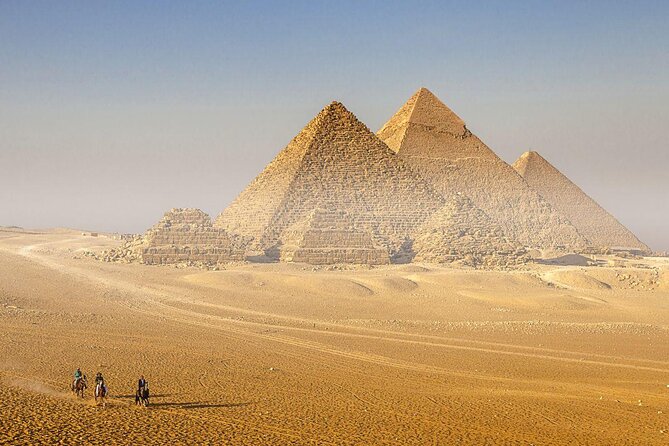
The day starts at the Giza Plateau, which is also called the Giza Necropolis. This site is huge, and the main advantage of going with a guide is not just access, it’s context. You’re seeing the Great Pyramid of Giza, the pyramids of Khafre and Menkaure, plus associated complexes and the Great Sphinx of Giza all in one area.
A few useful details to keep in mind while you’re there. The pyramids you’ll focus on were built during Egypt’s Fourth Dynasty of the Old Kingdom. The plateau is also roughly 9 km west of the Nile and about 13 km southwest of central Cairo, which helps explain why the route from the city is a real drive, not a quick hop.
Your time here is about 3 hours, and that’s enough to see the layout without feeling totally rushed. It’s also one of the best moments to orient yourself visually. You’ll start to understand how the monuments relate to the causeways, the valley temples, and the wider complex, even if you’re not a hardcore architecture nerd.
Cheops Pyramid to Khafre Pyramid: Three Stops, Three Scales
After the plateau introduction, you visit the major pyramids in sequence, each with its own time block.
The Great Pyramid of Cheops (Khufu) gets about 1 hour. The description you’re working from notes that Khufu’s pyramid complex includes a valley temple, now buried under the village of Nazlet el-Samman. It also mentions that certain paving and limestone walls were found but the site hasn’t been excavated. That kind of information helps you see beyond the photo. You’re not only looking at a structure, you’re looking at what’s known and what’s still unanswered.
Next is Khafre’s Pyramid, with about 30 minutes. Khafre’s complex is described as including a valley temple, a Sphinx temple, a causeway, a mortuary temple, and Khafre’s king’s pyramid. It even references statues found in a well in the floor of the temple by Mariette in 1860. If your guide shares facts like that, you’ll get more out of the minutes you spend there.
Then comes Menkaure’s Pyramid, also about 30 minutes. Menkaure’s complex includes a valley temple, a causeway, a mortuary temple, and the king’s pyramid, plus an added smaller ante-temple during the 5th Dynasty. In a short visit, it’s easy to miss why the pyramid matters, so listen for the guide’s point about the complex rather than only the pyramid shape.
A practical takeaway: because these are shorter time blocks, your best results come when you decide what you want from each pyramid. If you want scale, ask yourself what angle gives you the most perspective. If you want symbolism, focus on what you’re told about the surrounding temples and causeways.
Return trips to the Tahrir collection

The Great Sphinx: Where History Meets a Big Question
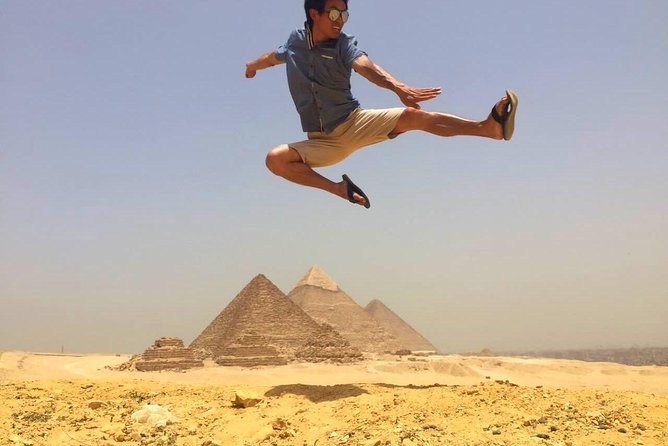
The Great Sphinx stop is about 1 hour. You’ll see it as part of the bigger complex, not as an isolated photo spot. The description notes that Egyptologists currently have a consensus that the Sphinx’s head is that of Khafre.
That statement is worth keeping in your head while you’re staring up at it. When you hear a theory, the best thing you can do is treat it like an informed guess that guides how you interpret the site. Even if you’re not trying to memorize scholarly arguments, the point is that the Sphinx is connected to the same royal world as the pyramids around it.
You’ll also hear about the “satellite” structures, including what are sometimes called the queens pyramids, causeways, and valley pyramids. This is where a guide helps you avoid the common mistake of only seeing the face.
Camel Ride Time: Short, Built In, and Usually the Fun Part
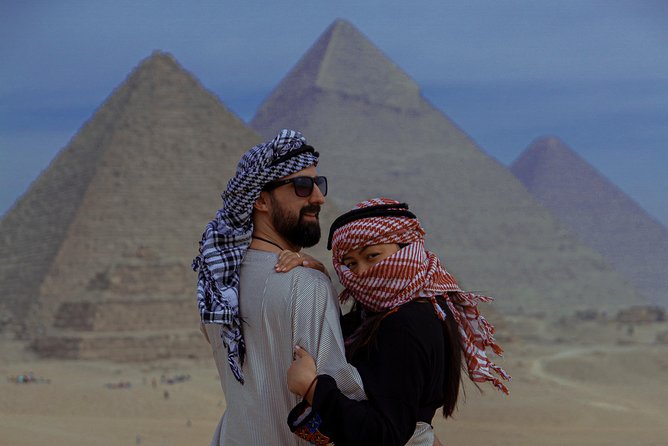
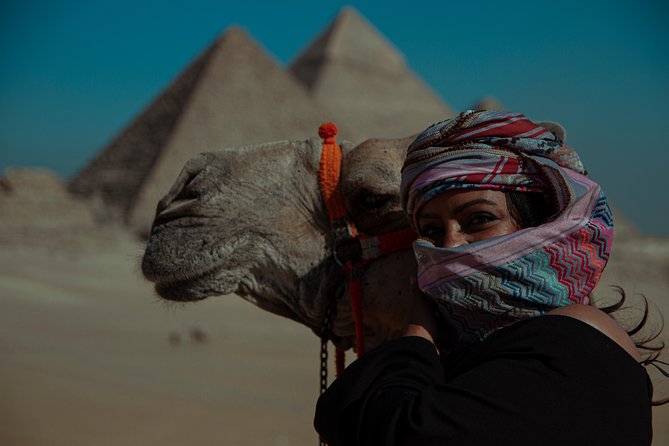
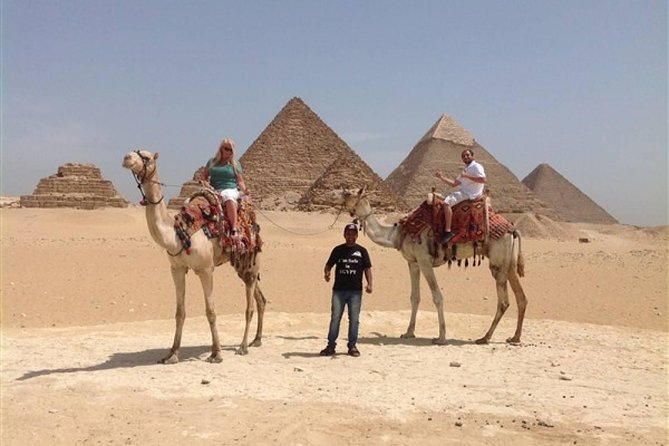
The camel ride is listed as always included, and it’s 30 minutes at the Giza Pyramids. That’s a nice length because it gives you the experience without eating your entire day. You can get the classic “camel and pyramids” photos, then still have time for the museum and the rest of the Sphinx complex.
Even if you’re not a “ride animals” person, this part can be a good break in pace. Outside at Giza can be dusty, bright, and tiring, so having a timed activity helps you plan your energy.
One more practical note: the itinerary also mentions snacks and water during the day at Giza. Since the tour includes bottled water, you’re not completely stuck on your own for hydration. Still, keep your own small snacks if you’re the type who gets hungry quickly, because meal stops are not guaranteed as part of the tour package.
Egyptian Museum in Cairo: Why This Stop Makes the Day Click
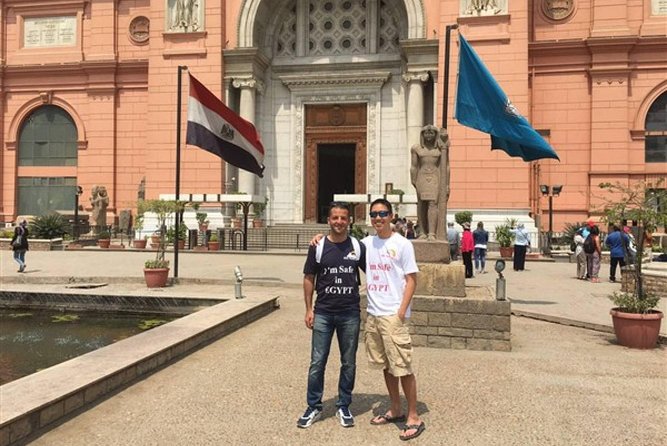
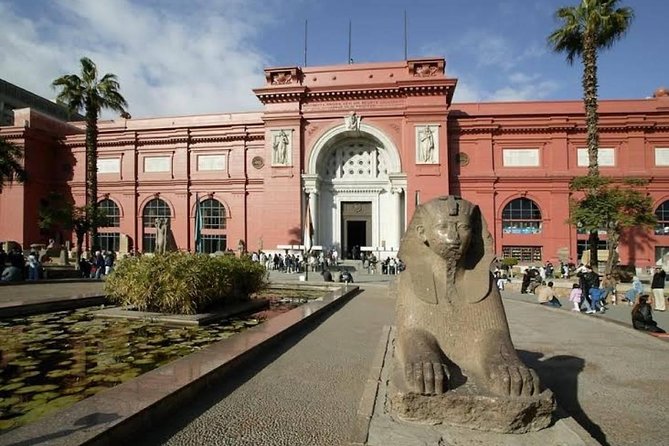
After Giza, the tour shifts to the Museum of Egyptian Antiquities in Cairo, commonly known as the Egyptian Museum. You spend about 3 hours here, and the highlight set is clearly spelled out: the King Tut exhibit, the Rosetta Stone, and other major historical artifacts.
This is where the tour offers real value for your understanding. Seeing pyramids outside is mind-blowing, but it’s also easy to feel like you’re looking at monuments with no “inside story.” The museum gives you objects tied to eras you just encountered at Giza, so your day feels more connected instead of two separate experiences.
A few museum facts that help you appreciate the building and collection. The museum has 120,000 items, but a representative amount is displayed, while the remainder is in storerooms. The building was completed in 1901, built by the Italian construction company Garozzo-Zaffarani to a design by French architect Marcel Dourgnon. And the museum’s status has been changing, with a note that it was open to the public as of March 2019 and due to be superseded by the Grand Egyptian Museum at Giza (mentioned for 2020 in the info provided).
That means your museum visit is not a “someday I will do it” idea. If you’re in Cairo now, this is the stop that puts key world-famous items in front of you during the same trip as the pyramids.
Timing, Lunch, and Energy: Keep a Simple Plan
The tour is long, and lunch is not included. The information here says lunch at local restaurants, including koshari, is optional. That’s common on sightseeing days, but it does mean you should think ahead about when you’ll eat and how long you can tolerate waiting.
A good approach is to treat the day like two halves. The Giza part includes snacks and water, so you can usually manage until museum time. Then, plan your lunch either before you start, during a break near the museum area, or right after if you prefer to avoid delaying the tour schedule.
Also, remember that entry fees can be a deciding factor. The info says entry fees include basic area only, and entrance fees may depend on tour options. If you get surprised at the museum gate, it can throw off your timing and patience. The smartest move is to confirm what’s covered when you book or when you meet your guide.
Price and Logistics: What You Pay, What You Don’t
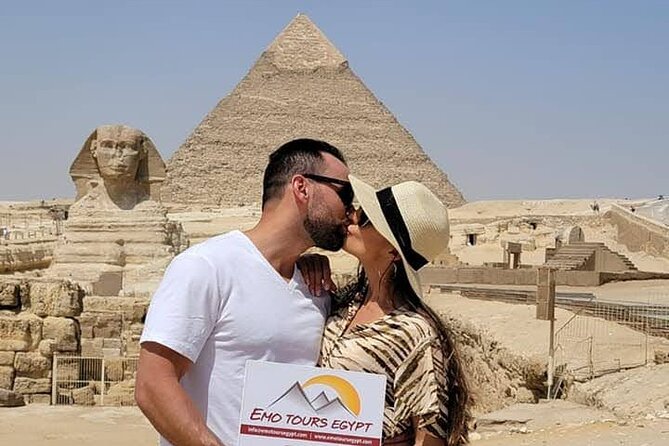
At $8 per person, you’re paying for a lot of structure: hotel pickup and drop-off, private AC transfers, bottled water, and a 30-minute camel ride. That’s the core “value engine” of this day.
Where money can shift is around entries and personal add-ons. The tour info says tipping is not included. It also says tour guide is optional, and entry fees may be optional depending on tour options chosen. Since entry fees are also described as basic area only, you should treat upgrades as possible.
So here’s the practical way to think about it. If you want just the major sights and the standard museum experience, the tour is set up for that. If you want extra access or very specific paid areas, you’ll need to confirm what is already covered by your selected option.
Guide Quality: The One Variable You Can Control
This kind of day lives or dies by the guide. The good news is your itinerary is already built to support a guide who shares context, not just directions. You’re spending time at the pyramid complexes and at the museum, so explanations make the difference between seeing monuments and actually understanding what you’re looking at.
There is also a hint of a potential trade-off. One example mentions a guide named Mohammad who could be funny and charismatic, but the historical knowledge was not always what you might want. If you want dates, dynasties, and clear connections between objects and monuments, ask questions directly.
You don’t need a lecture. Just ask things like which pyramid is which king, or why the Sphinx is linked to Khafre, and what to watch for inside the museum galleries.
Who Should Book This Tour
This tour is a good fit if:
- You’re visiting Cairo for a limited time and want Giza plus the Egyptian Museum in one day
- You prefer hotel pickup and air-conditioned transport rather than figuring it out yourself
- You want a quick camel ride without turning it into the whole plan
- You like straightforward sightseeing that still includes major names like the King Tut exhibit and the Rosetta Stone
It may be less ideal if you want long, slow wandering and deep, uninterrupted time for each site. The pyramid sections are split into shorter time blocks, and the museum gets about 3 hours, so you’ll be moving even if the museum gives you more breathing room than outdoor stops.
Should You Book This Full Day Giza Tour?
Book it if you want an efficient, affordable day with pickup, AC transport, key Giza monuments, a built-in camel ride, and a museum stop that includes major highlights. This is the kind of tour that helps you get the big picture quickly and then decide what you want to revisit later.
Skip it or adjust your expectations if you know you want a lot of extra paid access and you’re sensitive to the idea that some entry fees depend on options. In that case, confirm coverage before you go, so you’re not stuck making choices in the moment.
If you do book, your best strategy is simple: be clear about what you want to learn, bring patience for the scale of Giza, and use the museum time to connect the objects to what you saw outside.
FAQ
What time does the tour start?
The start time is listed as 8:00 am.
How long is the full day tour?
The duration is listed as about 8 to 10 hours.
Is hotel pickup and drop-off included?
Yes, the tour includes hotel pickup and drop-off in Cairo or Giza.
Is there a camel ride included, and how long is it?
Yes. A 30-minute camel ride at the Giza Pyramids is always included.
Is bottled water or snacks provided?
Bottled water is included. The Giza portion also mentions snacks and water.
What does the Egyptian Museum visit include?
The museum stop includes the King Tut exhibit, the Rosetta Stone, and other significant historical artifacts, and you spend about 3 hours there.
Are entry fees included?
The info notes that entry fees include basic area only, and entrance fees can depend on the tour options chosen.
Is lunch included?
No. Lunch is not included, but lunch at local restaurants, including koshari, is optional.
Is this tour private?
Yes. It’s described as a private tour or activity, so only your group participates.
Can I cancel for a full refund?
Yes. Cancellation is free, and you can cancel up to 24 hours in advance for a full refund.
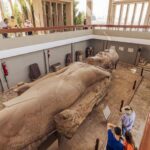
Back at the Tahrir Museum


Giza, A Few More Ways In

More of Cairo from our review pile
- Cairo Layover Tour to Giza Pyramids Egyptian Museum and Khan Khalili Bazaar
★ 5.0 · 25 reviews - Private Luxor Day tour from Cairo by Flight
★ 5.0 · 25 reviews - Private full day tour to Giza Pyramids, Sphinx, Sakkara and Dahshour with guided
★ 5.0 · 25 reviews - Nile Dinner Cruise in Cairo With Belly Dancing and Transfer
★ 5.0 · 25 reviews - Private Giza Pyramids,Sphinx,camel,lunch, 2 tombs,Great Pyramid
★ 5.0 · 25 reviews - All inclusive Giza Pyramids ,Sphinx ,Lunch ,Camel&Inside pyramid
★ 5.0 · 25 reviews
Giza Pyramids & Sphinx Tours, compared.
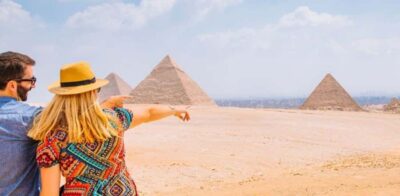 ★ 4.9Pyramids & Great Sphinx Private Tour with Camel RideFrom $486,335 reviews
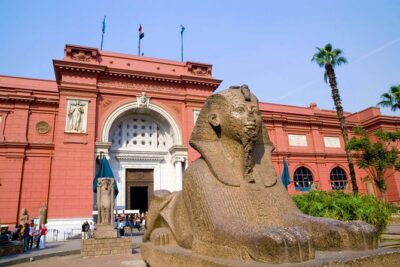 ★ 5.0Tour to Giza Pyramids and The Egyptian MuseumFrom $1556,016 reviews
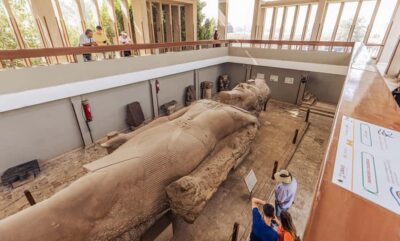 ★ 4.7Pyramids of Giza, Sphinx, Saqqara & Memphis TourFrom $903,110 reviews
 ★ 4.6Half-Day Tour to Pyramids of Giza and the SphinxFrom $502,891 reviews
 ★ 4.6Pyramids, Sakkara & Memphis Tour with LunchFrom $602,493 reviews
 ★ 5.0Private ViP all-inclusive Giza Pyramids,Sphinx,Inside PyramidFrom $142,448 reviews
 ★ 4.7Grand Egyptian Museum, Pyramids, Sphinx Tour & LunchFrom $892,282 reviews
 ★ 4.7Cairo Pyramids, Sphinx & Egyptian Museum Day TripFrom $932,271 reviews
The lists this one sits on